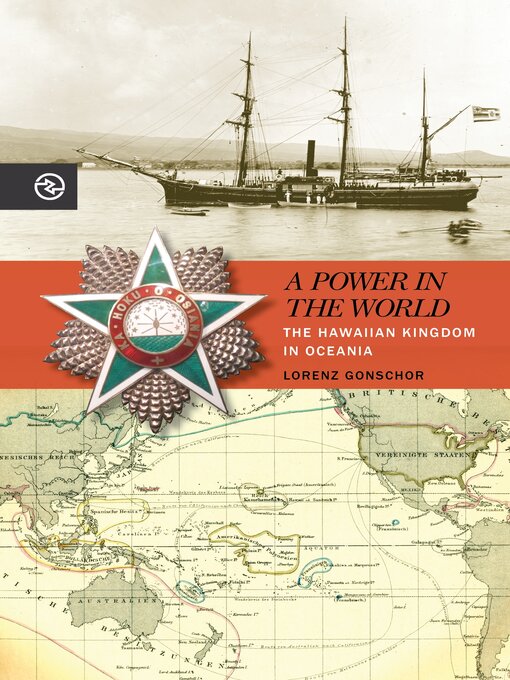
Few people today know that in the nineteenth century, Hawai'i was not only an internationally recognized independent nation but played a crucial role in the entire Pacific region and left an important legacy throughout Oceania. As the first non-Western state to gain full recognition as a coequal of the Western powers, yet at the same time grounded in indigenous tradition and identity, the Hawaiian Kingdom occupied a unique position in the late nineteenth-century world order. From this position, Hawai'i's leaders were able to promote the building of independent states based on their country's model throughout the Pacific, envisioning the region to become politically unified. Such a pan-Oceanian polity would be able to withstand foreign colonialism and become, in the words of one of the idea's pioneers, "a Power in the World."
After being developed over three decades among both native and non-native intellectuals close to the Hawaiian court, King Kalākaua's government started implementing this vision in 1887 by concluding a treaty of confederation with Sāmoa, a first step toward a larger Hawaiian-led pan-Oceanian federation. Political unrest and Western imperialist interference in both Hawai'i and Sāmoa prevented the project from advancing further at the time, and a long interlude of colonialism and occupation has obscured its legacy for over a century. Nonetheless it remains an inspiring historical precedent for movements toward greater political and economic integration in the Pacific Islands region today.
Lorenz Gonschor examines two intertwined historical processes: The development of a Hawai'i-based pan-Oceanian policy and underlying ideology, which in turn provided the rationale for the second process, the spread of the Hawaiian Kingdom's constitutional model to other Pacific archipelagos. He argues that the legacy of this visionary policy is today re-emerging in the form of two interconnected movements—namely a growing movement in Hawai'i to reclaim its legacy as Oceania's historically leading nation-state on one hand, and an increasingly assertive Oceanian regionalism emanating mainly from Fiji and other postcolonial states in the Southwestern Pacific on the other. As a historical reference for both, nineteenth-century Hawaiian policy serves as an inspiration and guideline for envisioning de-colonial futures for the Pacific region.
- Available now
- New eBook additions
- New kids additions
- New teen additions
- Most popular
- Great reads without the wait!
- See all ebooks collections
- Favorite Recorded Books Audio
- Available now
- New audiobook additions
- New kids additions
- New teen additions
- Most popular
- Try something different
- Family Road Trip Audiobooks
- Audiobooks for the Whole Family
- Great Narrators
- Always Available Audiobooks
- Listen While You Run: Audiobooks for Workouts
- Poetry is Meant to Be Spoken
- See all audiobooks collections
- Top Magazines - Now Available!
- Crafting & DIY
- Just added
- Sports
- Health & Fitness
- News & Politics
- Cars & Motorcycles
- Food & Cooking
- Business & Finance
- Revistas digitales
- 中文(简体
- 雑誌
- See all magazines collections